Introduction
If you have ever watched or played in a darts league, one question often comes up:
How does everything stay organised when multiple matches are happening at the same time?
Scores change quickly, players rotate, and results need to be recorded without slowing the game down. Yet most leagues manage to keep accurate standings and player stats throughout the season.
The answer lies in how leagues structure their tracking process — not just the tools they use.

What Actually Happens During a League Night
To understand tracking, it helps to look at what happens in a real league setting.
On a typical league night:
- Matches are scheduled in advance
- Players or teams are assigned to boards
- Each match result is recorded immediately after it finishes
In some leagues, one person (often the organiser or captain) handles all updates. In others, players are responsible for reporting their own results.
The key is timing — results are updated as games happen, not at the end of the night.
How Match Results Are Recorded
Every match follows a simple structure.
After a game:
- The winner is confirmed
- Scores for each leg are noted
- The final result is submitted or recorded
This process may seem basic, but consistency is what keeps everything accurate.
In organised leagues, results are often recorded in a shared system so they can be accessed by all players.
How Player Stats Are Built Over Time
Player stats are not created instantly — they build gradually across matches.
Leagues typically track:
- Wins and losses
- Average performance per game
- Checkout success
- Consistency across multiple matches
These stats are updated regularly and give players a clear view of their progress throughout the season.
Who Is Responsible for Tracking
Responsibility depends on how the league is organised.
Common approaches include:
- A designated organiser updating all results
- Team captains reporting match outcomes
- Players entering their own scores
Each method works as long as updates are consistent and accurate.
How UK Leagues Keep Everything Structured
In the pub darts community UK, structure is an important part of league play.
Most leagues follow a weekly schedule where:
- Matches happen on fixed days
- Results are recorded the same night
- Standings are updated regularly
To manage this, many leagues now use a UK darts league app to keep fixtures, results, and player stats organised in one place.
Some platforms also support tournament-style setups, working as a darts tournament app for pubs when events are held alongside league matches.
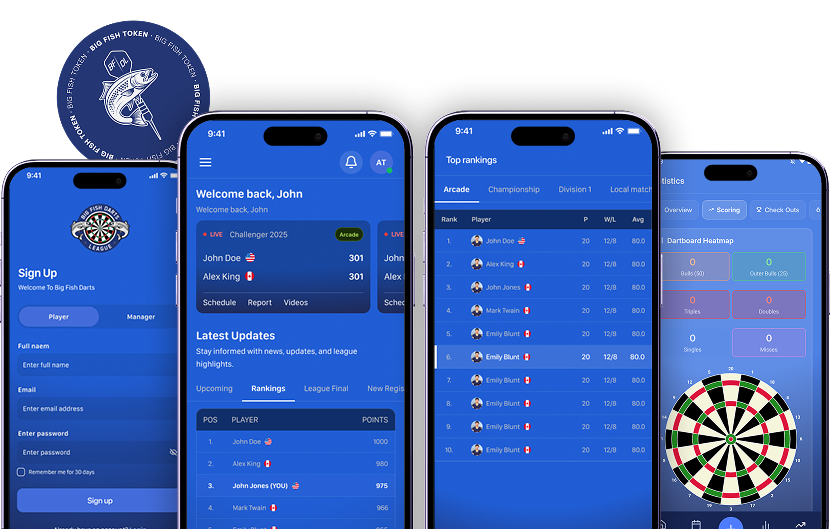
For example, tools like Big Fish Darts allow leagues to manage scoring, track player performance, and update standings without disrupting the flow of the game.
What Makes Tracking Work Smoothly
Successful leagues do not rely on complex systems. They focus on consistency.
Tracking works best when:
- Results are recorded immediately
- Everyone follows the same process
- Players know their responsibilities
- Updates are visible to all participants
This keeps the league organised and avoids confusion.
Common Issues Leagues Face
Even well-organised leagues can run into problems if:
- Results are recorded late
- Players forget to report scores
- Different methods are used inconsistently
Most of these issues come down to communication rather than tools.
FAQs
How are darts league results updated?
Results are usually recorded immediately after each match and added to a shared system or record.
Who tracks player stats in a darts league?
It can be an organiser, team captain, or the players themselves, depending on the league setup.
What stats are tracked in darts leagues?
Wins, averages, checkout performance, and consistency across matches.
How often are league standings updated?
In most leagues, standings are updated after each match night.
Do UK darts leagues follow a fixed structure?
Yes, most leagues in the UK follow a weekly format with organised fixtures and regular updates.
Conclusion
Darts leagues stay organised not because tracking is complex, but because the process is clear and consistent.
By recording results immediately, assigning responsibility, and updating stats regularly, leagues are able to manage multiple matches without confusion.
Whether using simple methods or structured tools, the key is keeping everything organised as the games happen.